A Framework for Mission-Driven Podcasts
If you work at a nonprofit, a university, a government agency, a faith-based organization, a professional association, or any organization where success is measured by mission rather than money, this framework is for you.
Most of what's been written about podcasting assumes you're trying to build an audience big enough to attract advertisers, or to make money directly through subscriptions and sponsorships. That advice isn't wrong. It just isn't built for what you're doing.
You're operating under different conditions. The market doesn't determine your podcast's success; someone at or near the top of an organizational chart does. Your goal isn't profit. It's to reach the right people, educate communities, and shape the public conversation about issues that matter. Its value isn't measured in dollars. It's measured in your leadership's confidence. And the factors that impact every decision are budget, time, and bureaucracy.
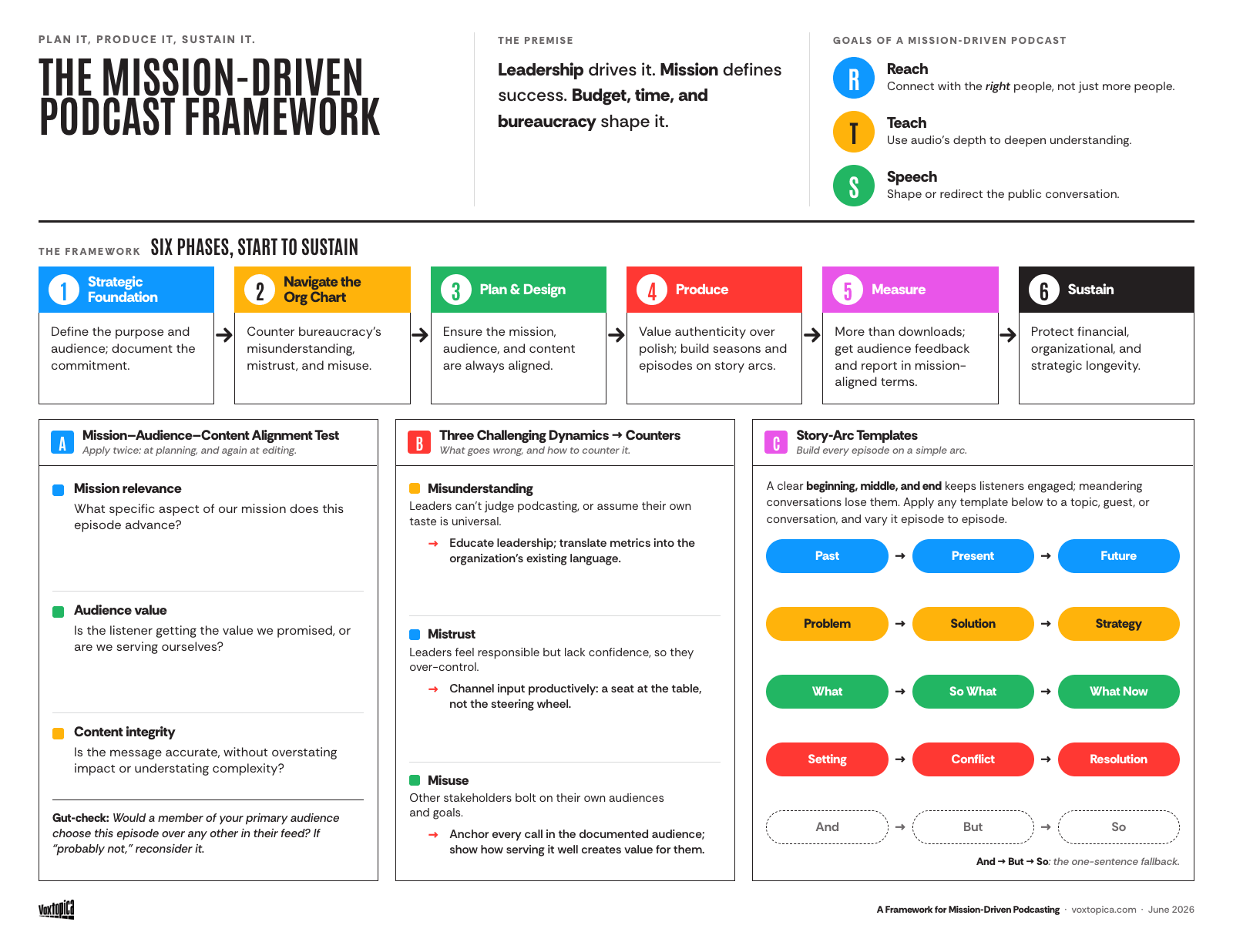
Six Phases summarize the Framework (click the headlines to see more). The image below provides a quick overview. Click here to download your copy of the Framework:
The Mission-Driven Podcast Framework
Six Phases, Start to Sustain
-
1
Define the purpose and audience, then document the commitment.
- Name the mission outcome this podcast exists to advance.
- Define a precise target audience — the right people, not just more people.
- Document leadership’s commitment of budget, time, and editorial independence.
-
2
Counter bureaucracy’s misunderstanding, mistrust, and misuse.
- Educate leadership; translate podcast metrics into the organization’s language.
- Give stakeholders a seat at the table, not a hand on the steering wheel.
- Anchor every decision in the documented audience, not internal agendas.
-
3
Keep mission, audience, and content in alignment from the start.
- Run the Mission–Audience–Content alignment test at planning.
- Choose a format that fits the audience and the resources you have.
- Map a season and a repeatable episode structure.
-
4
Value authenticity over polish; build every episode on a story arc.
- Build each episode on a clear beginning, middle, and end.
- Favor authentic conversation over over-produced polish.
- Re-run the alignment test at the edit, before release.
-
5
Look past downloads; gather feedback and report in mission terms.
- Look past download counts to audience feedback and engagement.
- Report results in the organization’s existing language of value.
- Use what you learn to sharpen the next season.
-
6
Protect the show’s financial, organizational, and strategic longevity.
- Secure ongoing budget and a realistic production cadence.
- Keep organizational buy-in alive as leadership changes.
- Protect the show’s strategic focus over the long term.